the family of designs descending from Ralph Merkle's hash trees, where a parent commits to its children by containing their hashes, so one trusted root authenticates an arbitrarily large structure.
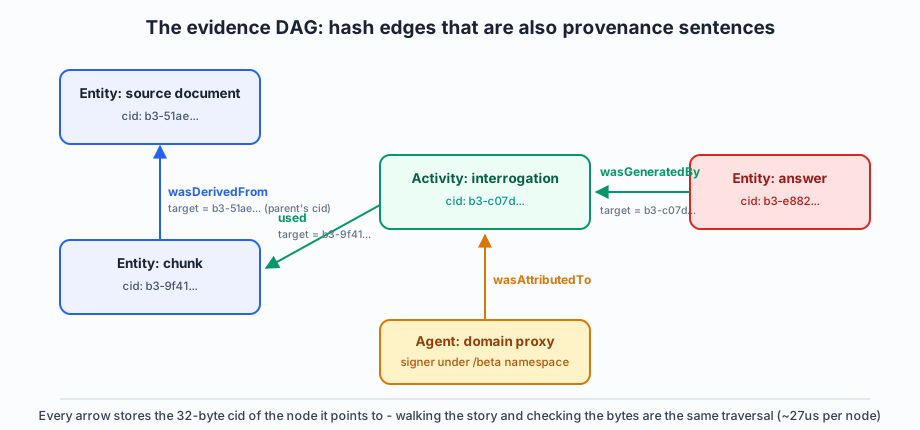
A Merkle structure wearing provenance types - hash edges that are also sentences.
Hand-authored SVG for this glossary, 2026. Node and edge types per W3C PROV-DM; cid-in-edge invariant per the paper's Section on the evidence object.
Etymology and backstory
Merkle described hash trees in 1979 as a way to sign many one-time keys with a single value. The pattern became one of the most reusable ideas in computer science: embed hash-of-child inside parent, and tampering anywhere breaks the chain upward and is detected at the root.
Ecosystem
certificate transparency logs, Bitcoin and every blockchain, git, ZFS and Btrfs checksum trees, BitTorrent v2, Dat and Hypercore - all Merkle lineage. The differences are in what the nodes MEAN, never in the integrity mechanics.
In codexproof
the contribution is not inventing a Merkle structure - it is TYPING the edges with W3C PROV semantics, so the hash links are also meaningful provenance claims (this was derived from that; this activity used that entity), then putting a signed, revocable, namespaced trust plane over who may assert them. Merkle gives tamper-evidence; the types give it a story; the signatures give the story an author.