a database indexed for nearest-neighbor search over embedding vectors - you query with a vector and get back the stored items whose vectors are closest, which operationally means "most semantically similar."
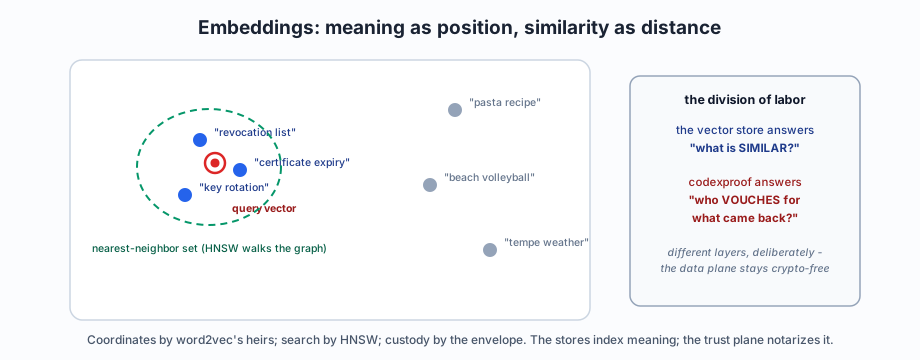
What the store answers and what it cannot: similarity on the left, custody on the right.
Etymology and backstory
nearest-neighbor search is classic (k-d trees, locality- sensitive hashing), but the 2017-2020 embedding boom created demand for billion- scale approximate nearest neighbor (ANN) at millisecond latency. Algorithms like HNSW (hierarchical navigable small worlds, Malkov and Yashunin) and product quantization (Jegou et al.) made it practical; the LLM wave productized it into a database category almost overnight.
Ecosystem
Pinecone, Qdrant, Weaviate, Milvus as dedicated engines; pgvector and Supabase bolting vectors onto Postgres; FAISS as the research workhorse library. Eric's fleet runs several of these across his domains - the four-store testbed of the paper is exactly this layer.
In codexproof
vector stores are the DATA PLANE - queried natively by the gateway with the operator's own credentials, never touched by the trust machinery (the Q16 locks). The paper's claim is pointedly store-agnostic: the waist sits ABOVE Pinecone, Supabase, and Qdrant, sealing what they return without caring which one returned it. Also the retort to the soft-reject reviewer: this system governs evidence custody at the vector-store layer, not LLM management.