the architecture where a language model's answer is grounded by first retrieving relevant documents from an external store and stuffing them into the prompt - the model generates FROM evidence instead of purely from weights.
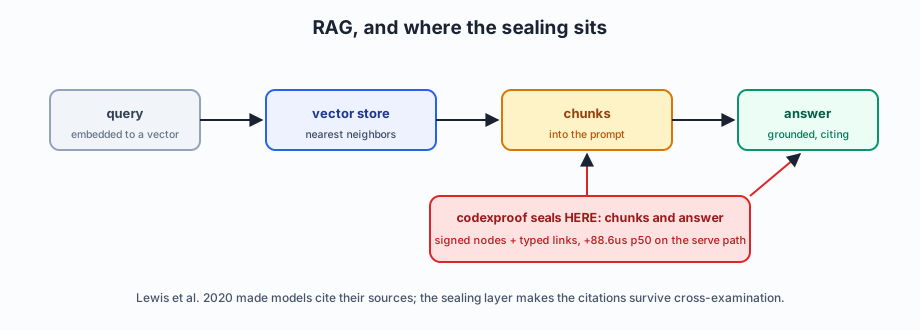
The retrieval loop, and the exact point where sealing attaches to it.
Etymology and backstory
the acronym comes from the 2020 paper "Retrieval-Augmented Generation for Knowledge-Intensive NLP Tasks" (Lewis et al., Facebook AI Research), though grounding generation in retrieval has deeper roots (open-domain QA systems, DrQA, REALM). RAG won because it solves three model problems at once: stale knowledge, hallucination pressure, and the inability to cite. It turned vector stores into infrastructure.
Ecosystem
effectively every production LLM application with private or current data - enterprise assistants, coding copilots reading repos, agent stacks. The "retrieval" leg is what Pinecone, Qdrant, Supabase pgvector, and the embedding industry exist to serve.
In codexproof
RAG is the client whose evidence gets sealed. The paper's three workflow moments all sit on the RAG path: what did retrieval return, from which store, derived from which source, handed to which agent. The answer-to-evidence edge (gloss four) is precisely the link from a generated answer back to the retrieved chunks it consumed.