a learned mapping from content - text, images, code - into a dense numeric vector such that semantic similarity becomes geometric closeness; the representation that makes vector search possible.
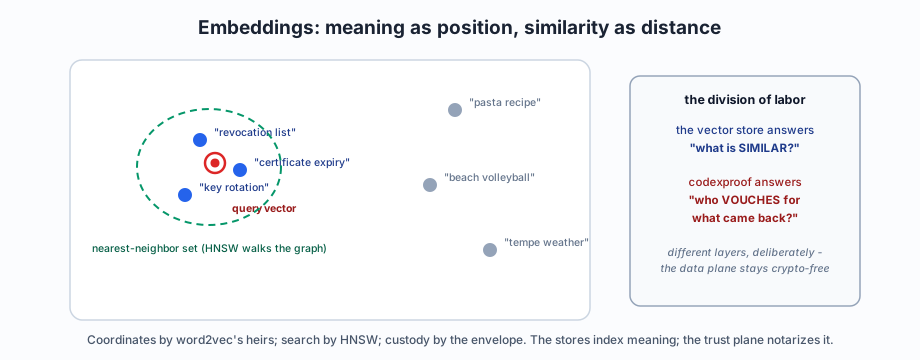
Meaning as coordinates: closeness is similarity, and the query is just another point.
Etymology and backstory
the word borrows from mathematics (embedding one space into another). The lineage runs from latent semantic analysis (1990) through word2vec (Mikolov et al., 2013), which made "king minus man plus woman equals queen" a cultural moment, to sentence and document transformers (Sentence-BERT, 2019) and today's commercial embedding APIs. The conceptual shift: meaning as position in a space, learned from data rather than authored in an ontology.
Ecosystem
every RAG pipeline embeds queries and chunks; recommendation systems, semantic deduplication, clustering, anomaly detection - embeddings are the universal adapter of the ML era. Metered commercial APIs (OpenAI, Voyage) make embedding a real line item - which is why Eric's spend rules gate them.
In codexproof
embeddings are what vector stores index, and they sit strictly on the data plane. The paper's measurement design deliberately avoids computing any (synthetic templates, zero metered calls). Provenance-wise, an embedding is a derived artifact - a wasDerivedFrom edge from chunk to vector is exactly the kind of lineage the system can seal when a deployment chooses to record it.