Remote ATtestation procedureS - the IETF architecture (RFC 9334) for one party producing EVIDENCE about the state of its hardware and software so a relying party can appraise it; attestation is the general act of a system vouching for its own configuration with cryptographic backing.
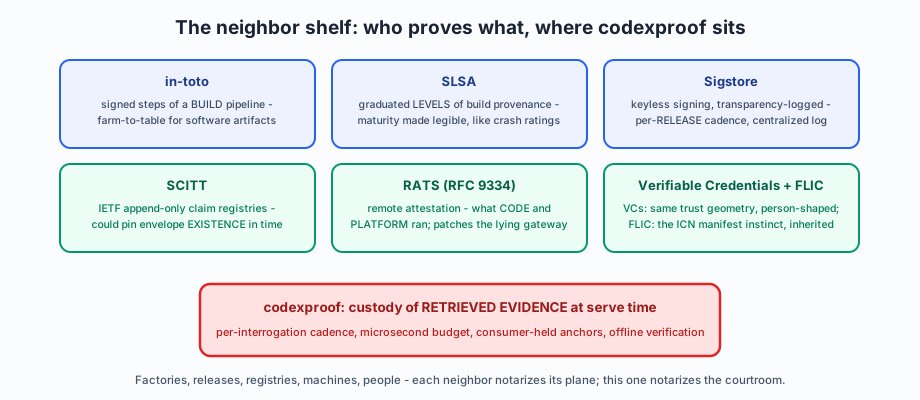
The shelf: RATS proves the machine; the red box proves the bytes - stacked, the lying gateway runs out of room.
Etymology and backstory
attestation grew up in trusted computing (TPMs measuring boot chains, then SGX and TDX enclaves proving code identity to remote parties). RFC 9334 (2023) standardized the vocabulary: attester, verifier, relying party, evidence, endorsements, appraisal policy. The word itself is legal Latin - attestari, to bear witness.
Ecosystem
confidential computing (proving a workload runs in a genuine enclave), device onboarding, mobile app integrity APIs; increasingly cited in AI-governance conversations about proving which model or pipeline actually ran.
In codexproof
Section VI's composition point (an Aug-strata delta): codexproof proves data lineage - what bytes, whose signature, what derivation; RATS-style attestation proves EXECUTION context - what code, what platform. They compose: an attestation about the gateway or proxy binary would answer the mis- declaration concession (Q18's feed-it-lies tier) at the layer codexproof deliberately leaves open. The paper cites RFC 9334 as exactly this complementary rail.