revealing some fields of a signed object while withholding others, without breaking the signature - done by committing to hidden fields with salted hashes so the signature covers commitments, not plaintext.
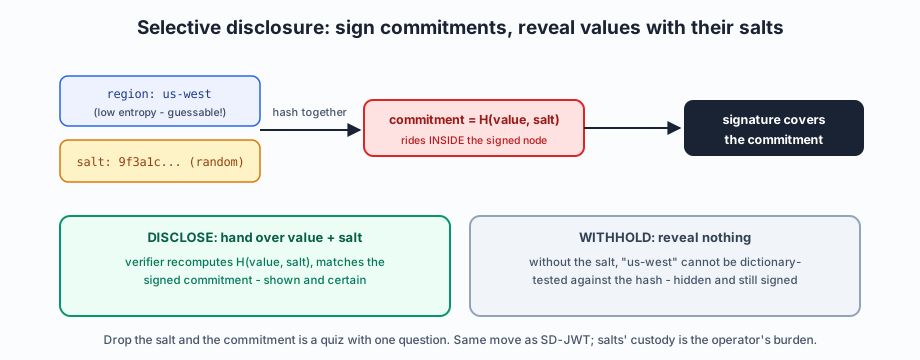
Disclose with the salt or withhold entirely - the signature never learns the difference.
Etymology and backstory
the problem is as old as credentials: prove you are over 21 without showing your address. Cryptography's answers range from heavyweight (zero-knowledge proofs, BBS+ signatures, anonymous credentials from Chaum onward) to pragmatic: hash each field with a per-field random salt, sign the list of hashes, and disclose field-plus-salt only for what you choose to reveal. The pragmatic form went mainstream as SD-JWT in the OAuth world in the 2020s.
Ecosystem
SD-JWT (IETF), verifiable credentials with BBS+ signatures, mDL (mobile driver's licenses, ISO 18013-5) - all the same disclosure dance at different formality levels.
In codexproof
the salted-commitment form. Hidden fields ride as salted hashes inside the signed node; disclosure hands over value plus salt, and the verifier recomputes. The salt prevents dictionary attacks on low-entropy fields (without it, "amount: 100" hides nothing - you would just try all plausible amounts). The paper compresses this into one generic passage after the in-out-in disclosure saga (Q7); salt custody is an operator burden noted in Q18's tier-2 edges.