data leaving a system's boundary - the bytes-out that clouds meter and bill; in codexproof's producer-side cost model, egress is essentially the whole bill.
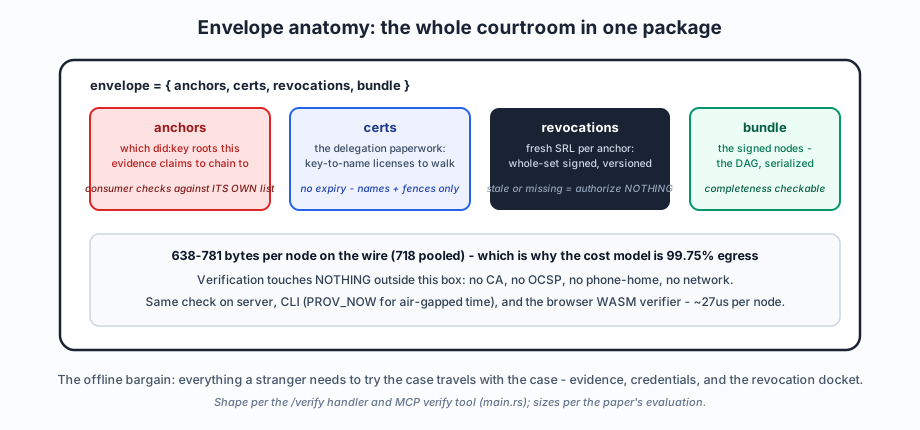
Where the bill lives: the bytes crossing the wire, not the crypto inside them.
Hand-authored SVG for this glossary, 2026. Shape per the /verify handler; sizes per the paper's evaluation.
Etymology and backstory
egress is Latin for the way out; cloud economics made it a loaded word because providers charge for bytes leaving (and famously not for entering), making data gravity a business model. Cost-per-unit analysis of infrastructure designs - working the arithmetic from unit prices to marginal cost - is the discipline the paper applies to sealed provenance.
Ecosystem
every cloud bill argument, CDN economics, the egress-fee regulation debates of the mid-2020s.
In codexproof
the $0.065 per million sealed nodes number decomposes as 99.75 percent egress and only ~400th-ish crypto - the envelope's 718 pooled bytes crossing the wire dominate; the Ed25519 and BLAKE3 arithmetic is financially invisible. Which yields the paper's cleanest economic sentence: the marginal cost of trust is the cost of SHIPPING the proof, not computing it.