a mathematical scheme where a private key produces, over a message, a short proof that anyone holding the matching public key can check - authenticity and non-repudiation without shared secrets.
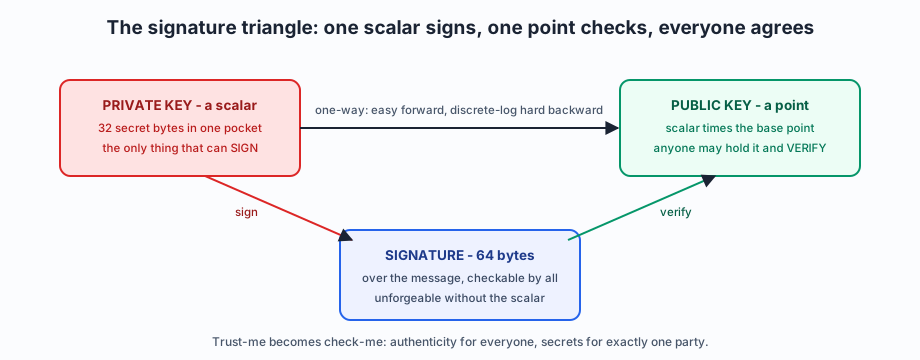
The triangle: one scalar signs, one point verifies, everyone agrees.
Etymology and backstory
proposed conceptually by Whitfield Diffie and Martin Hellman in the 1976 paper "New Directions in Cryptography" - they described the idea before anyone knew how to build it. RSA realized it in 1978. The modern security bar was set by Goldwasser, Micali, and Rivest in 1988: existential unforgeability under chosen- message attack, meaning even an attacker who can request signatures on messages of their choosing cannot forge one new signature on any new message.
Ecosystem
TLS certificates, software updates, git tags, JWTs, blockchain transactions, passports. Civilization's load-bearing primitive for "this specific party said this specific thing."
In codexproof
every provenance node ships as a SignedNode - the node bytes, the cid, the signer identity, and an Ed25519 signature over the domain-separated cid. The signature answers WHO sealed it; the cid answers WHAT was sealed; the trust schema answers whether that WHO was entitled to.