in elliptic-curve cryptography the private key is a scalar - a very large number - and the public key is a point on the curve, computed as scalar times a fixed base point; easy to compute forward, believed infeasible to reverse.
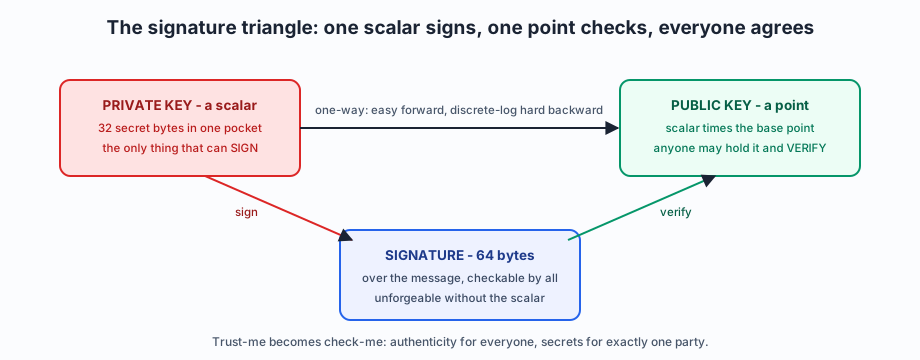
The scalar signs; the point verifies; the walk between them is one-way.
Etymology and backstory
elliptic curves entered cryptography independently through Neal Koblitz and Victor Miller in 1985. The one-way street is the elliptic-curve discrete logarithm problem: given the base point and the resulting point, recovering the scalar has no known shortcut, so roughly 128-bit security fits in 256-bit keys - an order of magnitude smaller than equivalent RSA.
Ecosystem
every modern handshake (TLS key exchange), Signal's ratchet, SSH keys, cryptocurrency wallets - all scalar-times-point underneath.
In codexproof
a domain's anchor secret is 32 bytes of scalar sitting in a file; its public identity is the corresponding point, serialized into a did:key string. The Q19 theft story is literally "someone copied the scalar."