the architectural pattern where many diverse things above and many diverse things below all interoperate through ONE narrow, stable interface in the middle - the hourglass shape that let the Internet scale.
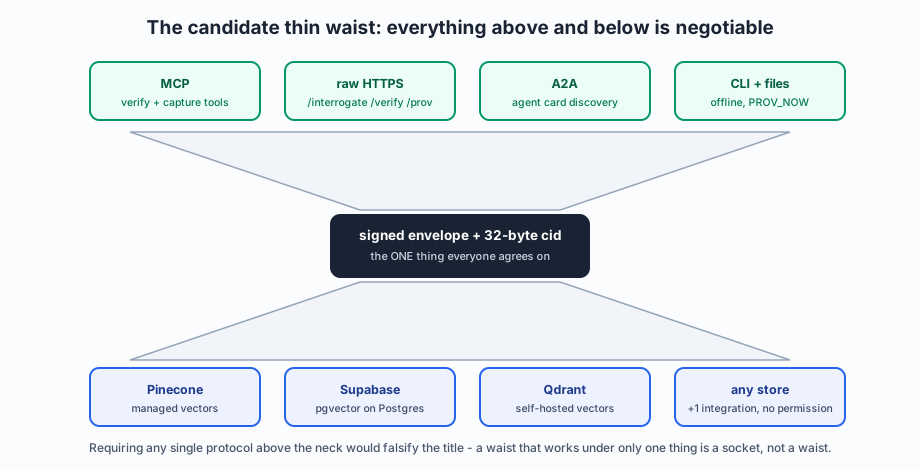
The hourglass itself: four doors above, four stores below, one agreement at the neck.
Hand-authored SVG for this glossary, 2026. Surfaces per main.rs routes; the calibration word "candidate" per the paper's own claim discipline.
Etymology and backstory
the canonical thin waist is IP itself - email, web, video above; ethernet, wifi, fiber below; everything crossing through one minimal packet format. The design-theory account of WHY the hourglass works (a minimal spanning layer maximizes what can evolve on both sides) is the paper's hourglass citation. NDN's founding argument was that the waist was built for conversations between hosts while the world wanted named data - so move the waist up.
Ecosystem
POSIX as an OS waist, LLVM IR as a compiler waist, containers as a deployment waist - the pattern recurs wherever ecosystems must evolve on both sides of a stable middle.
In codexproof
the paper's title claim, carefully calibrated as CANDIDATE thin waist: the signed, content-addressed evidence object is the neck; MCP, raw HTTPS, A2A, and CLI file-handoff above; Pinecone, Supabase, Qdrant, pgvector below. The waist is the ENVELOPE, not any protocol - which is why requiring MCP would falsify the title (Q17).